FPE, Zinsco, and Pushmatic Panels: The Complete North County San Diego Homeowner’s Guide
If someone told you your electrical panel might be dangerous — or your insurance company just made it very clear they think so — this guide will tell you exactly what you’re dealing with, how serious it is, and what your realistic options are.
The Panel in Your Garage Might Be Costing You Your Insurance
Most homeowners never think about their electrical panel. It’s a gray metal box on a wall. It does its job invisibly, and unless a breaker trips during a storm, you forget it exists.
That invisibility is exactly what makes the current insurance situation so disorienting for North County San Diego homeowners. You didn’t change anything. You didn’t file a bunch of claims. You didn’t do anything wrong. And yet State Farm, Farmers, Allstate, USAA, or Mercury sent you a letter saying they won’t be renewing your policy.
The reason, buried somewhere in the fine print or communicated through your agent, is your electrical panel brand.
This guide breaks down everything you need to know — which panels are being flagged, why they’re genuinely dangerous (not just bureaucratically inconvenient), what your options are, and what the upgrade process looks like from start to finish in North County San Diego.
Which Panels Are Insurers Flagging — and Why?
Three panel families account for the vast majority of insurance non-renewals related to electrical systems in California right now.
Federal Pacific Electric (FPE) Stab-Lok Panels
Years installed: Approximately 1950–1990
Identifying features: Look for “Federal Pacific,” “FPE,” or “Stab-Lok” on the panel door or breakers
Why it’s flagged: Breaker failure rate — breakers don’t trip when they should
FPE was one of the most widely used panel manufacturers in post-war America. Millions of homes were built with their Stab-Lok panels, and for decades, most of them appeared to work fine. The problem only became clear through independent testing in the 1980s: FPE Stab-Lok breakers fail to trip at alarming rates.
In a circuit breaker, “tripping” — cutting power to a circuit — is the only safety function that matters. When a circuit is overloaded or a fault occurs, the breaker is supposed to trip and stop the flow of electricity. If it doesn’t, that electricity keeps flowing into wiring, insulation, and structural material until something ignites.
Independent studies found that some FPE double-pole breakers failed to trip in more than half of all tests. The company was investigated for fraudulent UL certification. FPE eventually went out of business, but they were never forced to recall their panels — meaning millions remain installed in American homes today, including a substantial number throughout North County San Diego.
The insurance industry has concluded, as a matter of actuarial fact, that these panels represent an unacceptable fire risk. That conclusion is reflected in your non-renewal letter.
Zinsco Panels (sold under Zinsco, Sylvania, and GTE-Sylvania)
Years installed: Approximately 1950s–1970s
Identifying features: Look for “Zinsco,” “Sylvania,” or “GTE-Sylvania” on the panel
Why it’s flagged: Breakers can fuse to the bus bar, making them impossible to turn off
Zinsco panels have a specific and well-documented failure mode: over time, the aluminum used in their breakers reacts with the bus bar — the metal strip that distributes power through the panel — and the two can literally fuse together.
When a Zinsco breaker fuses to the bus bar, it cannot trip. You cannot flip it off manually. You cannot shut off power to that circuit. Even if a fault occurs, even if you’re standing there watching a breaker that you know should be tripping, you cannot stop the current flow without cutting power to the entire panel from outside the home.
Zinsco was acquired and phased out in the 1970s. Like FPE, their panels were never recalled. Like FPE, they remain in a significant portion of Southern California’s older housing stock — particularly in communities like Carlsbad, Escondido, and Vista where homes from that era are common.
Pushmatic Panels (ITE, Siemens-ITE, Bulldog)
Years installed: Approximately 1950s–1980s
Identifying features: Push-button breakers instead of toggle switches; look for “Pushmatic,” “ITE,” or “Bulldog”
Why it’s flagged: Parts are no longer manufactured; panels cannot be properly serviced
Pushmatic panels operate on a different principle than toggle-switch breakers. They use a push-button mechanism — you push in to reset a tripped breaker. The design itself isn’t inherently dangerous in the way FPE or Zinsco are, but there’s a practical problem that’s become impossible to ignore:
Pushmatic replacement parts no longer exist.
The manufacturer stopped production decades ago. Any licensed electrician who needs to work inside a Pushmatic panel — replacing a breaker, adding a circuit, servicing a fault — cannot obtain compatible parts through normal supply channels. That means the panel cannot be properly maintained, upgraded, or repaired as electrical needs change.
From an insurer’s perspective, an unserviceable panel is an uninsurable panel. A system that cannot be brought up to code, that cannot be safely modified, and that has no manufacturer support is a liability they’re no longer willing to carry — especially in a market where they’re already reducing California exposure.
“My Panel Isn’t One of Those Three — Am I Fine?”
Maybe. But there are a few other scenarios worth knowing about.
Undersized panels. Many homes built in the 1970s and 80s were wired with 100-amp panels — which was adequate for the electrical loads of that era. Today’s homes often run EV chargers, heat pumps, solar inverters, home offices, and large appliances simultaneously. A 100-amp panel that’s consistently running near capacity creates its own set of risks and may flag on some insurer checklists even if the brand isn’t on the problem list.
Aluminum branch wiring. Some homes from the 1965–1975 period were wired with aluminum branch circuit wiring instead of copper. This is a separate issue from the panel brand, but it’s often found in the same homes — and it’s also flagged by some carriers. If you’re getting a panel inspection, it’s worth asking about the branch wiring as well.
Double-tapped breakers and DIY modifications. If previous owners or unlicensed contractors added circuits by double-tapping breakers (connecting two wires to a breaker designed for one), that’s a code violation that can show up in an inspection and affect insurability. A licensed electrician will spot this immediately.
The Real Financial Comparison — What Each Path Actually Costs
Homeowners who delay panel upgrades almost always do so because of the upfront cost. Here’s the full financial picture that makes the $3,500–$5,500 upgrade look like exactly what it is: the cheapest option on the table.
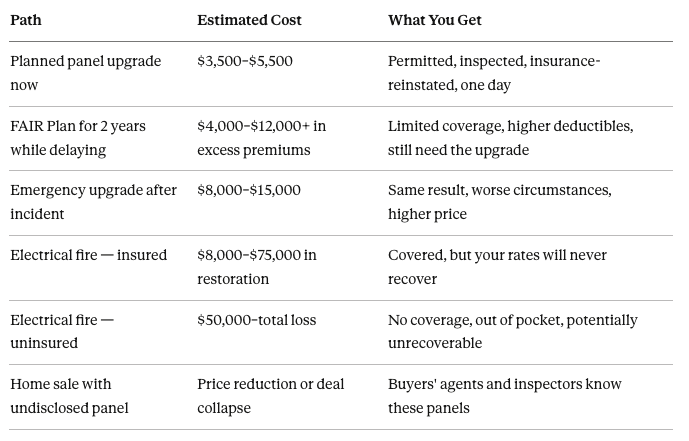
The $3,500–$5,500 number represents a planned, permitted, professionally executed upgrade — the best-case scenario. Every path that involves delay makes that number larger, either through excess insurance premiums, emergency pricing, or the cost of an incident.
In most cases, the premium savings from returning to standard market coverage after a panel upgrade recover the cost of the upgrade within 12–18 months.
What a Good Panel Upgrade Actually Includes
Not all panel upgrades are equal. Here’s what a properly executed job in North County San Diego includes — and what to watch for if you’re getting multiple quotes.
✓ Licensed and insured contractor In California, panel replacement must be performed by a licensed C-10 electrical contractor. This isn’t optional and it’s not negotiable with your insurance company. An unlicensed installation produces zero usable documentation and can create its own legal liability if you try to sell the home later.
✓ Permit pulled with the city Every panel upgrade requires a permit from the relevant city or county authority. The permit is what generates the inspection sign-off, which is what your insurance company needs. If a contractor offers to do the job without pulling a permit, walk away.
✓ SDG&E coordination Your utility provider needs to disconnect service at the meter before the panel can be safely replaced. A reputable contractor handles this coordination as part of the job. It adds a scheduling step but it’s not your responsibility to manage.
✓ Proper panel sizing for current and future loads A good contractor doesn’t just swap out your old panel for a 200-amp equivalent and call it done. They assess your current electrical load, ask about planned additions (EV charger, solar, heat pump), and size the panel accordingly. Getting this wrong means another upgrade in five years.
✓ City inspection and sign-off After installation, a city inspector verifies the work. This is the critical document. It’s what proves to your insurance carrier that the work was done to code, by a licensed contractor, with proper oversight.
✓ Insurance documentation The signed permit and inspection certificate are what you submit to your carrier. A good contractor makes sure you leave with these documents in hand.
Why Timing Matters More Than Most Homeowners Realize
There’s a specific misconception worth addressing directly: many homeowners who receive non-renewal letters assume they can take their time, shop around, and get this done whenever it’s convenient.
Here’s why that thinking is risky:
Your carrier’s clock doesn’t stop. The non-renewal date on your letter is the date your coverage ends. Getting a quote takes time. Scheduling a job takes time. Coordinating SDG&E takes time. Waiting for the city inspection takes time. If you start the process in week 3 of a 30-day notice window, you’re likely uninsured for some period between your old policy lapsing and your carrier reinstating coverage after the upgrade.
Contractor availability is real. North County San Diego has a finite number of licensed electricians who do permitted panel work at this volume. During peak demand — which the current insurance situation has created — scheduling windows extend. Getting on a reputable contractor’s calendar sooner is meaningfully better than waiting.
The insurance market is still tightening. The carriers pulling back from California are not returning. The underwriting standards being applied today will be applied more broadly tomorrow. Homeowners who upgrade proactively are ahead of that tightening. Homeowners who wait are increasingly finding themselves chasing a standard that keeps moving.
North County San Diego Specifics: Why This Region Is Particularly Affected
If you’re in Carlsbad, Oceanside, Vista, Escondido, or San Marcos and wondering why this seems to be hitting your neighborhood particularly hard, the explanation is straightforward:
The housing stock age matches the panel era. North County saw substantial residential development in the 1960s, 70s, and 80s. FPE, Zinsco, and Pushmatic panels were the industry standard during those decades. A large percentage of homes in these communities have original panels that have never been replaced — not because previous owners were negligent, but because the panels appeared to function and there was no prior incentive to replace them.
Wildfire risk compounds the electrical risk. California insurers are managing wildfire exposure across their entire portfolio. North County’s proximity to fire-prone terrain means these homes are already carrying elevated risk in the insurer’s model. An outdated electrical panel on top of that wildfire exposure is often the tipping point that moves a property from “expensive to cover” to “we won’t cover it at all.”
In Carlsbad alone, Copper Crest Electric has completed over 47 panel upgrades in the last six months. Most of those homeowners waited until they had no choice. The ones who scheduled proactively paid lower prices, had more scheduling flexibility, and avoided any gap in coverage.
Get a Free On-Site Inspection — Know Exactly Where You Stand
If you’re not sure what panel you have, if you’ve received a non-renewal letter, or if you just want to know your status before an insurer makes the decision for you — Copper Crest Electric offers a free on-site inspection by a licensed electrician.
We’ll identify your panel, assess your load, tell you exactly what your insurer will require, and give you a written quote with no obligation. We handle the permit, SDG&E coordination, and city inspection. Most North County residential jobs are completed in a single day.
Serving Carlsbad, Oceanside, Vista, Escondido, San Marcos, and all of North County San Diego.
Frequently Asked Questions
How do I know for certain if I have an FPE, Zinsco, or Pushmatic panel?
Open your panel’s outer door and look for the brand name on the inside label or on the breakers themselves. If you see Federal Pacific, FPE, Stab-Lok, Zinsco, Sylvania, GTE-Sylvania, Pushmatic, ITE, or Bulldog — call a licensed electrician. If you can’t identify the brand or the panel looks very old, a free inspection is the right next step.
Can I replace just the breakers instead of the whole panel?
No — not in a way that satisfies insurance underwriting requirements. For FPE and Zinsco panels in particular, the problem isn’t solely the breakers; it’s the panel chassis and bus bar design. Insurers require full panel replacement with a new, code-compliant unit from a current manufacturer.
My home inspector didn’t flag my panel when I bought the house. Why is this coming up now?
Home inspectors are generalists. They’re not always familiar with the full history of flagged panel brands, and their inspection standards vary. The insurance industry’s underwriting criteria have also tightened significantly in the last 2–3 years. A panel that didn’t raise a flag in 2018 may be a disqualifying item under 2025 underwriting standards.
Will my homeowner’s insurance cover the cost of the upgrade?
No. Homeowner’s insurance covers sudden, accidental losses — not maintenance, upgrades, or known defects. The panel upgrade is an out-of-pocket expense. Some contractors offer financing; ask about this when you get your quote.
How long will the new panel last?
A properly installed, modern 200-amp panel from a current manufacturer has a typical service life of 40–60 years. You’re not doing this again.
What brand of panel will be installed?
Reputable electricians install panels from established, currently manufactured brands — Square D, Eaton, Siemens, and Leviton are among the most common. These are the brands insurance companies accept without question.
Copper Crest Electric is a licensed, insured electrical contractor serving North County San Diego.