State Farm, Farmers, and Allstate Are Canceling Home Insurance in North County San Diego — Here’s Why Your Electrical Panel Is the Reason
If you’ve received a non-renewal letter from your homeowner’s insurance carrier — or you’re worried you might — your electrical panel is almost certainly why. Here’s what’s happening, what it means for your home, and what North County homeowners are doing about it right now.
Why Are Insurance Companies Dropping Homeowners in North County San Diego?
Over the past 18 months, major carriers including State Farm, Farmers, Allstate, USAA, and Mercury have quietly begun canceling or non-renewing homeowner policies across North County San Diego — Carlsbad, Oceanside, Vista, Escondido, San Marcos, and surrounding communities.
While wildfire risk gets most of the headlines, there’s a second, less-publicized reason policies are being pulled: outdated electrical panels.
Specifically, insurers have identified three panel brands that they now consider too high-risk to cover:
- Federal Pacific Electric (FPE) / Stab-Lok panels
- Zinsco panels (also sold under the brand Sylvania)
- Pushmatic panels
If your home was built between 1950 and 1990, there’s a significant chance you have one of these panels. Estimates suggest that 55–65% of North County homes have panels that are either flagged by insurers, nearing end of life, or undersized for today’s electrical demands.
Your insurer can cancel your policy with as little as 30 days’ notice. Most homeowners only find out when the letter arrives.
What’s Wrong with FPE, Zinsco, and Pushmatic Panels?
These panels were installed in millions of American homes and were considered standard at the time. The problem isn’t that they’re old — it’s that they fail in ways that modern panels don’t.
Federal Pacific Electric (FPE) Stab-Lok Panels
FPE Stab-Lok breakers have a documented history of failing to trip during overloads and short circuits. When a breaker doesn’t trip, current keeps flowing — into wiring, into walls, and potentially into a fire. Investigative studies going back to the 1980s found failure rates as high as 51% in certain double-pole breakers. FPE went out of business, and the panels have never been recalled — meaning millions are still in homes today.
Zinsco Panels
Zinsco breakers are prone to a specific and dangerous defect: the breaker can fuse — literally melt — to the bus bar, making it impossible to shut off power to a circuit. Like FPE, a breaker that can’t trip is a breaker that can’t protect your home. Zinsco was acquired and discontinued in the 1970s, but their panels remain in use throughout Southern California.
Pushmatic Panels
Pushmatic panels (made by ITE/Siemens) use a push-button design instead of traditional toggle breakers. While not as definitively dangerous as FPE or Zinsco, they are no longer manufactured, meaning replacement parts are unavailable or extremely difficult to source. Any electrician who needs to work inside one faces a parts problem — and insurers increasingly view them as uninsurable for that reason alone.
The Real Cost of Waiting
This is where most homeowners make a critical mistake. They receive the letter, feel overwhelmed, set it aside, and assume they have time.
You don’t have as much time as you think.
Here’s what the numbers actually look like:
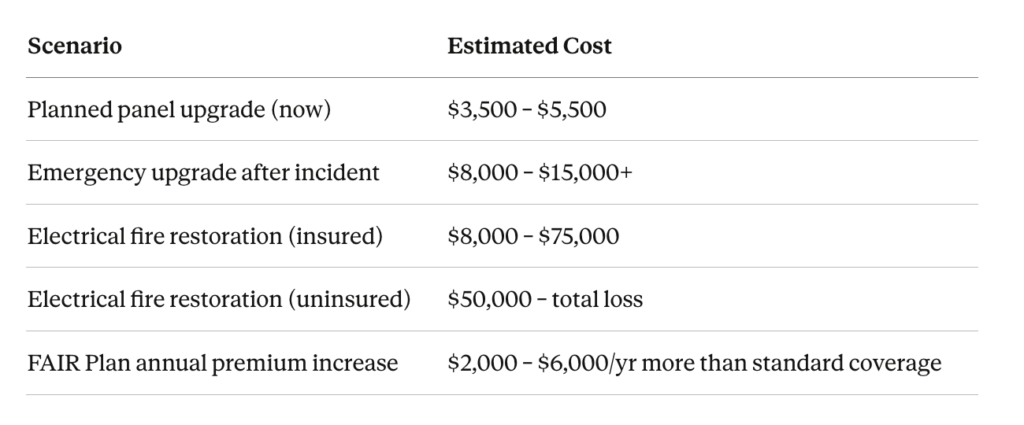
Once your standard carrier drops you, your next stop is California’s FAIR Plan — the insurer of last resort. FAIR Plan premiums are significantly higher than standard market rates, coverage is more limited, and even FAIR Plan has begun tightening its own underwriting standards. In some cases, homeowners are finding themselves uninsurable through any carrier until the panel is replaced.
A panel upgrade that costs $3,500–$5,500 today pays for itself within 12–18 months in avoided FAIR Plan premium increases alone — before you factor in the safety and home value benefits.
“How Do I Know If I Have One of These Panels?”
You don’t need to be an electrician to check. Here’s what to look for:
Step 1: Go to your electrical panel (usually in the garage, utility room, or on an exterior wall).
Step 2: Open the panel door and look for the manufacturer name. It’s usually printed on a label inside the door or stamped on the breakers themselves.
Step 3: Look for these names:
- Federal Pacific Electric, FPE, or Stab-Lok
- Zinsco or Sylvania
- Pushmatic or ITE
Step 4: If you see any of these names — or if you’re not sure — stop. Don’t start pulling breakers or testing anything yourself. Call a licensed electrician for an inspection.
If your panel is older and you don’t recognize the brand at all, that’s also worth a call. Many panels from the 1960s–1980s that aren’t on the “flagged” list are still undersized for modern electrical loads — EV chargers, heat pumps, home offices, and modern appliances draw significantly more power than homes were wired for 40 years ago.
What Does the Panel Upgrade Process Actually Look Like?
One of the biggest reasons homeowners delay is that they don’t know what to expect — and they assume it will be disruptive, confusing, and expensive.
Here’s the reality of a panel upgrade done by a licensed North County electrician:
1. Free on-site inspection A licensed electrician visits your home, assesses your existing panel, reviews your current electrical load, and gives you a clear written quote. No guessing, no vague estimates.
2. Permit pulled with the city All panel upgrades require a permit. A reputable contractor handles this for you. This is not optional — unpermitted panel work creates its own insurance problems and can complicate a future home sale.
3. SDG&E coordination Your utility provider needs to be notified and will typically disconnect power briefly on the day of the job. Your electrician coordinates this so you don’t have to navigate it alone.
4. Installation — usually one day For most residential panel upgrades in North County, the job is completed in a single day. You’ll have power back the same day in virtually all cases.
5. Inspection and sign-off The city inspector signs off on the completed work. This is the document your insurance carrier needs.
6. Carrier notification Your electrician provides you with the permit completion documentation. You or your agent submits it to your carrier. Most homeowners in this situation have their coverage reinstated within 1–2 weeks.
What North County Homeowners Are Saying
“I got a letter from Farmers in November saying they weren’t renewing my policy. I had no idea it was because of my panel. Copper Crest came out for the free inspection, explained everything clearly, and had the job done in one day. Farmers reinstated my coverage two weeks later. Wish I’d done it years ago.” — Carlsbad homeowner
“I kept putting it off because I thought it would be a huge project. It wasn’t. They handled the permit, called SDG&E, and were in and out in six hours. I don’t know why I waited.” — Oceanside homeowner
Why This Is Becoming More Urgent — Not Less
The insurance situation in California is not stabilizing. It’s accelerating.
State insurance regulators have been attempting to reform the market, but carriers are still pulling back from high-risk areas and high-risk properties. Electrical panels are increasingly being written into underwriting checklists as a standard disqualifying factor — not just for older homes, but for any home with a panel that can’t be documented as compliant.
What that means practically: the window to handle this proactively is closing. Homeowners who upgrade now do so on their own timeline, with competitive pricing, and with a planned permit and inspection process. Homeowners who wait do so reactively — after an incident, after a cancellation, after the FAIR Plan, or after a failed home inspection at the time of sale.
Schedule Your Free Panel Inspection in North County San Diego
If you have an FPE, Zinsco, or Pushmatic panel — or if you’ve received a non-renewal letter and aren’t sure why — Copper Crest Electric offers a free on-site inspection by a licensed electrician.
We’ll tell you exactly what your panel status is, what your insurer will require, and what it costs to fix it. No obligation, no sales pressure.
We serve Carlsbad, Oceanside, Vista, Escondido, San Marcos, and all of North County San Diego. We handle permits, SDG&E coordination, and inspection sign-offs. Most jobs are completed in a single day.
Copper Crest Electric is a licensed, insured electrical contractor serving North County San Diego. CA Contractor Licensed.
Frequently Asked Questions
Will my insurance company really cancel my policy because of my panel?
Yes. State Farm, Farmers, Allstate, USAA, and Mercury have all issued non-renewals in North County San Diego specifically citing FPE, Zinsco, and Pushmatic panels. This is documented and ongoing.
How much does a panel upgrade cost in North County San Diego?
The typical range for a residential panel upgrade in North County is $3,500–$5,500, depending on panel size, access, and whether any additional wiring work is needed. We provide exact written quotes after the free inspection.
How long does the job take?
Most residential panel upgrades are completed in one day. Power is restored the same day.
Will my insurance be reinstated after the upgrade?
In most cases, yes — once you provide your carrier with the signed permit and inspection documentation, they reinstate coverage. We’ve seen this happen in as little as one week.
Do I need to be home during the inspection?
Yes. The free on-site inspection takes about 30–45 minutes and requires access to your electrical panel. We work around your schedule.
What if I’m not sure what brand my panel is?
That’s exactly what the free inspection is for. Our licensed electrician will identify your panel, assess its condition, and tell you whether it’s flagged by current insurance underwriting standards.